
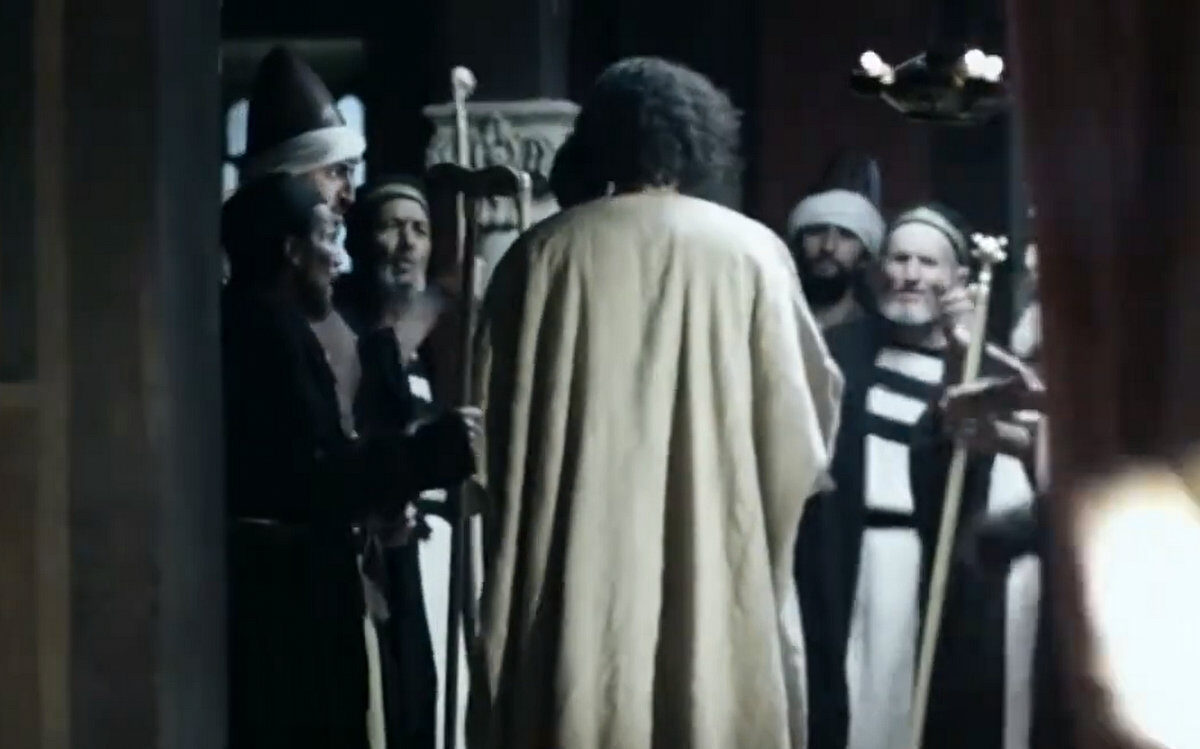
Scriptures: John 18:12-24; Matthew 26:57-68
Jesus Faces Annas and Caiaphas
John 18:12-14
So the detachment, the commanding officer, and the officers of the Jews, seized Jesus and bound him, 13 and led him to Annas first, for he was father-in-law to Caiaphas, who was high priest that year. 14 Now it was Caiaphas who advised the Jews that it was expedient that one man should perish for the people.
Peter Denies Jesus
John 18:15-18
Simon Peter followed Jesus, as did another disciple. Now that disciple was known to the high priest, and entered in with Jesus into the court of the high priest; 16 but Peter was standing at the door outside. So the other disciple, who was known to the high priest, went out and spoke to her who kept the door, and brought in Peter.
17 Then the maid who kept the door said to Peter, “Are you also one of this man’s disciples?” He said, “I am not.”
18 Now the servants and the officers were standing there, having made a fire of coals, for it was cold. They were warming themselves. Peter was with them, standing and warming himself.
The High Priest Questions Jesus
John 18:19-24
The high priest therefore asked Jesus about his disciples, and about his teaching. 20 Jesus answered him, “I spoke openly to the world. I always taught in synagogues, and in the temple, where the Jews always meet. I said nothing in secret. 21 Why do you ask me? Ask those who have heard me what I said to them. Behold, these know the things which I said.”
22 When he had said this, one of the officers standing by slapped Jesus with his hand, saying, “Do you answer the high priest like that?”
23 Jesus answered him, “If I have spoken evil, testify of the evil; but if well, why do you beat me?”
24 Annas sent him bound to Caiaphas, the high priest.
Jesus Before Caiaphas and the Council
Matthew 26:57-68
Those who had taken Jesus led him away to Caiaphas the high priest, where the scribes and the elders were gathered together. 58 But Peter followed him from a distance, to the court of the high priest, and entered in and sat with the officers, to see the end.
Now the chief priests, the elders, and the whole council sought false testimony against Jesus, that they might put him to death; 60 and they found none. Even though many false witnesses came forward, they found none. But at last two false witnesses came forward, 61 and said, “This man said, ‘I am able to destroy the temple of God, and to build it in three days.’”
62 The high priest stood up, and said to him, “Have you no answer? What is this that these testify against you?”
63 But Jesus held his peace. The high priest answered him, “I adjure you by the living God, that you tell us whether you are the Christ, the Son of God.”
64 Jesus said to him, “You have said it. Nevertheless, I tell you, after this you will see the Son of Man sitting at the right hand of Power, and coming on the clouds of the sky.”
65 Then the high priest tore his clothing, saying, “He has spoken blasphemy! Why do we need any more witnesses? Behold, now you have heard his blasphemy. 66 What do you think?” They answered, “He is worthy of death!”
Then they spat in his face and beat him with their fists, and some slapped him, 68 saying, “Prophesy to us, you Christ! Who hit you?”
This passage from John 18:19-24 is a classic example of a Socratic fallacy. The high priest is asking Jesus a question that appears to be seeking information, but is actually designed to trap Jesus into admitting something that would be detrimental to Him.
A Socratic fallacy occurs when someone asks a question that appears to be seeking information or clarification but is actually designed to trap or deceive the person answering. The goal is often to create a situation where the person answering is put on the defensive, forced to admit a weakness, or led to a contradictory or embarrassing conclusion.
In this case, the high priest’s question is designed to create a false dichotomy or to force Jesus to make an admission that they may not be willing to make.
But notice how Jesus always knew how to answer, and said that he had taught openly – it was public knowledge, and to ask those who heard what he taught.
But a certain one of them, Caiaphas, being high priest that year, said to them, “You know nothing at all, nor do you consider that it is advantageous for us that one man should die for the people, and that the whole nation not perish.” Now he didn’t say this of himself, but being high priest that year, he prophesied that Jesus would die for the nation, and not for the nation only, but that he might also gather together into one the children of God who are scattered abroad. So from that day forward they took counsel that they might put him to death. (John 11:49-53 WEB)
Now in the fifteenth year of the reign of Tiberius Caesar, Pontius Pilate being governor of Judea, and Herod being tetrarch of Galilee, and his brother Philip tetrarch of the region of Ituraea and Trachonitis, and Lysanias tetrarch of Abilene, in the high priesthood of Annas and Caiaphas, the word of God came to John, the son of Zacharias, in the wilderness. (Luke 3:1-2 WEB)
As they spoke to the people, the priests and the captain of the temple and the Sadducees came to them, (2) being upset because they taught the people and proclaimed in Jesus the resurrection from the dead. (3) They laid hands on them, and put them in custody until the next day, for it was now evening. (4) But many of those who heard the word believed, and the number of the men came to be about five thousand. (5) In the morning, their rulers, elders, and scribes were gathered together in Jerusalem. (6) Annas the high priest was there, with Caiaphas, John, Alexander, and as many as were relatives of the high priest.
(7) When they had stood Peter and John in the middle of them, they inquired, “By what power, or in what name, have you done this?”
(8) Then Peter, filled with the Holy Spirit, said to them, “You rulers of the people, and elders of Israel, (9) if we are examined today concerning a good deed done to a crippled man, by what means this man has been healed, (10) be it known to you all, and to all the people of Israel, that in the name of Jesus Christ of Nazareth, whom you crucified, whom God raised from the dead, in him does this man stand here before you whole. (11) He is ‘the stone which was regarded as worthless by you, the builders, which has become the head of the corner.’ (12) There is salvation in none other, for neither is there any other name under heaven, that is given among men, by which we must be saved!”
(13) Now when they saw the boldness of Peter and John, and had perceived that they were unlearned and ignorant men, they marveled. They recognized that they had been with Jesus. (14) Seeing the man who was healed standing with them, they could say nothing against it.
(15) But when they had commanded them to go aside out of the council, they conferred among themselves, (16) saying, “What shall we do to these men? Because indeed a notable miracle has been done through them, as can be plainly seen by all who dwell in Jerusalem, and we can’t deny it. (17) But so that this spreads no further among the people, let’s threaten them, that from now on they don’t speak to anyone in this name.”
(18) They called them, and commanded them not to speak at all nor teach in the name of Jesus.
(19) But Peter and John answered them, “Whether it is right in the sight of God to listen to you rather than to God, judge for yourselves, (20) for we can’t help telling the things which we saw and heard.”
(21) When they had further threatened them, they let them go, finding no way to punish them, because of the people; for everyone glorified God for that which was done. (22) For the man on whom this miracle of healing was performed was more than forty years old. (Acts 4:1-22 WEB)